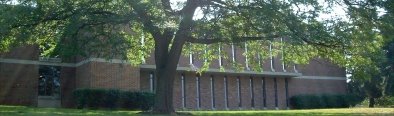
For my final roundtable of the conference, I attended the Information Commons roundtable led by members of the Information Commons staff from Asbury Theological Seminary. Last year, quite a large group attended their presentation on the Information Commons model; this was a much smaller group interested in continuing the conversation about how Asbury has made the Information Commons model work for them.
Asbury established their Information Commons in 2003, but, due to faculty demand, they added a Faculty Information Commons (FIC) in 2004. The FIC is staffed with four people drawn from other parts of the library and information technology areas: one librarian, one person from I.T., one person from media services, and one person from ExL, the extended learning program using Moodle for online courses. The FIC supports around 50 full time faculty members plus many additional adjuncts, assisting them with online course development, providing media services, and training them in the use of software and media devices. The result has not only been greater collaboration with the faculty in teaching and learning, but a greater horizontal collaboration across library and information technology staff as well.
Jared Porter and Paul Tippey also shared a number of observations based on Transforming Library Service Through Information Commons, by D. Russell Bailey and Barbara Gunther Tierney. According to Bailey and Tierney, institutions that move from the traditional separation between Information Technology departments and the library to a shared Information Commons model go through four stages:
I. Adjustment level -- there may be a computer lab in the library, but its functions are separate or it is run by library staff.
II. Isolated change -- library computers include more productivity software, and there is some integration of staff functions across departments.
III. Far-Leading change -- the library and I.T. share in collaboration with faculty, and the boundaries of the library become functional rather than physical.
IV. Transformational change -- there is full integration of library and I.T. functions, and the resulting Information Commons is an active participant in the educational mission of the institution.
As institutions move through these four stages, the tendency is for service models to become less data-centric or collection-centric and to become more user-centric in both their accommodation for user needs and their presentation of I.C. services.
I have not read Bailey and Tierney's book, and listening to the Asbury staff, it is clear that the Asbury I.C. is a vital part of Asbury's educational program that is successfully meeting the needs of both faculty and students for both library and I.T. services. I do not, however, understand the assumptions behind Bailey and Tierney's four stages. It sounds to me like a false dichotomy between a poorly managed library and a well-managed one. Even before the advent of the Internet and I.T. departments, a library's mission was never defined by the walls of the library building. Librarians have an excellent track record of serving both local and distant information needs through interlibrary loan, consortial arrangements, and document delivery services. As is abundantly clear in the ATS standards, the library is and has been a vital part of the educational mission of the institution. Close collaboration between library staff and faculty in teaching and learning is the assumed norm, not something new that dropped down from heaven with the advent of the podcast.
To the extent that the I.C. model eliminates information silos and departmental turf battles, I think it is a wonderful model. One reason the Asbury I.C. model is as successful as it is is because they have also ensured the continued delivery of traditional library services. In addition to their cross-trained I.C. staff, they also have full time librarians who are available for reference and research assistance not provided by the front-lines workers. I hope someday to be able to visit the Asbury I.C. as it looks to me like it has been carefully thought out and creatively designed. I am reassured to hear that in the midst of their many technological and departmental transformations, they have also continued to offer the educational services that librarians have always offered even without the I.C. model.
Showing posts with label IT. Show all posts
Showing posts with label IT. Show all posts
Saturday, June 28, 2008

Friday, September 14, 2007
Libraries and Computer Labs
The Chronicle's Wired Campus has an article about the lack of public workstations in public libraries. This article is in turn reporting on an AP story about the increasing demand for Internet access in public libraries. All of this reporting on libraries and computers has been spawned by ALA'a recently released report (227 p.; 6+ MB):
Libraries Connect Communities: Public Library Funding & Technology Access Study 2006 - 2007.
(Many thanks to Jessamyn West at librarian.net for providing the location of the ALA report.)
Public libraries, of course, operate differently than academic libraries. Where public libraries are often the sole providers of free Internet access in their communities (so say 73% of the public libraries that responded to the ALA survey), academic libraries are usually not the sole source of Internet access on their campuses. Apart from technology owned by the students themselves, there is always the computer lab, or, if your campus is large enough, the computer labs.
Which raises in my mind the question of the relationship between the library and campus computer labs. At the annual ATLA conference in Philadelphia this past June, there was an interesting and somewhat hotly debated presentation by Dr. Kenneth Boyd and his staff from the Information Commons at Asbury Theological Seminary. In the evolving world of I.T. and libraries, Asbury's Information Commons represents a melding of these two worlds where library services and I.T. services all come from the same department. Librarians at Asbury may answer reference questions about theological research, or they may assist students with the correct configuration of their wireless proxy settings or the correct formatting of footnotes in their Word documents. (Something that many of us do anyway, regardless of how closely our libraries are aligned with campus I.T.)
In theological libraries in particular, there is a noticeable generational gap between the computer skills of our younger and our older students. Seminaries tend to have more older students than many other types of graduate institutions, with average student ages trending up toward the 40s at the turn of the century. For older students, many of whom are returning to education for the first time in over 20 years, there is a profound technology shock. The last time they did academic research, they were using card catalogs and paper periodical indexes.
Which brings me to my question: Should academic libraries in general or theological libraries in specific include a computer lab as part of the library? If the library does not include a computer lab, where do students, particularly those without computer skills, learn to use computers for academic research and writing?
Space concerns often dictate one answer to this question. The 1960s and 1970s saw a lot of academic library expansion and building projects on a national scale; for many of our libraries, though, there has not been any significant building or expansion over the past 30+ years, leaving us with little room for books much less technologies that did not exist when our buildings were built. Any public library building project that I have seen over the past decade has devoted significantly more space to computers than previous designs; I believe academic library building projects have been more mixed as to how much priority is given to computer space.
If your library space allows room for a computer lab, you are still left with the question of whether libraries are well-suited to provide computer services. If 73% of our public libraries are the only available community spaces for Internet access, does that set a standard for academic libraries as well? The answer to this question is evolving; how fast it evolves is up to us.
Libraries Connect Communities: Public Library Funding & Technology Access Study 2006 - 2007.
(Many thanks to Jessamyn West at librarian.net for providing the location of the ALA report.)
Public libraries, of course, operate differently than academic libraries. Where public libraries are often the sole providers of free Internet access in their communities (so say 73% of the public libraries that responded to the ALA survey), academic libraries are usually not the sole source of Internet access on their campuses. Apart from technology owned by the students themselves, there is always the computer lab, or, if your campus is large enough, the computer labs.
Which raises in my mind the question of the relationship between the library and campus computer labs. At the annual ATLA conference in Philadelphia this past June, there was an interesting and somewhat hotly debated presentation by Dr. Kenneth Boyd and his staff from the Information Commons at Asbury Theological Seminary. In the evolving world of I.T. and libraries, Asbury's Information Commons represents a melding of these two worlds where library services and I.T. services all come from the same department. Librarians at Asbury may answer reference questions about theological research, or they may assist students with the correct configuration of their wireless proxy settings or the correct formatting of footnotes in their Word documents. (Something that many of us do anyway, regardless of how closely our libraries are aligned with campus I.T.)
In theological libraries in particular, there is a noticeable generational gap between the computer skills of our younger and our older students. Seminaries tend to have more older students than many other types of graduate institutions, with average student ages trending up toward the 40s at the turn of the century. For older students, many of whom are returning to education for the first time in over 20 years, there is a profound technology shock. The last time they did academic research, they were using card catalogs and paper periodical indexes.
Which brings me to my question: Should academic libraries in general or theological libraries in specific include a computer lab as part of the library? If the library does not include a computer lab, where do students, particularly those without computer skills, learn to use computers for academic research and writing?
Space concerns often dictate one answer to this question. The 1960s and 1970s saw a lot of academic library expansion and building projects on a national scale; for many of our libraries, though, there has not been any significant building or expansion over the past 30+ years, leaving us with little room for books much less technologies that did not exist when our buildings were built. Any public library building project that I have seen over the past decade has devoted significantly more space to computers than previous designs; I believe academic library building projects have been more mixed as to how much priority is given to computer space.
If your library space allows room for a computer lab, you are still left with the question of whether libraries are well-suited to provide computer services. If 73% of our public libraries are the only available community spaces for Internet access, does that set a standard for academic libraries as well? The answer to this question is evolving; how fast it evolves is up to us.
Subscribe to:
Posts (Atom)


