Showing posts with label ATLA Conference. Show all posts

Friday, October 31, 2008

Room for Lots of Librarians in St. Louis

This is the lobby of the Millennium Hotel in St. Louis where the American Theological Library Association will hold the opening reception for their annual conference during June 17-20, 2009.

I'm in St. Louis right now meeting with the Education Committee and the Annual Conference Committee to plan what is shaping up to be an excellent conference for next summer. What follows is a brief pictorial preview of what everyone will be able to enjoy in June.

The conference will be in the Millennium Hotel:
with a great view of the Arch from the North Tower rooms:
One of the highlights of the conference will be our day on Concordia's beautiful campus when we will be able to enjoy seeing the Luther Tower with its 49-bell carillon:
Wartburg Commons:
Share in worship in the Chapel of St. Timothy and St. Titus:
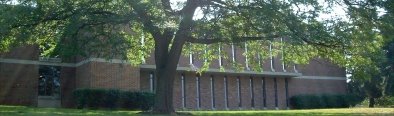
And, of course, browse the books, art, and Reformation materials in the library:
A picture from inside the library:
Luther Tower reflected in the fountain outside the library:

I'm looking forward to seeing everyone in St. Louis in June.

Saturday, June 28, 2008

Information Commons: A New Concept?

For my final roundtable of the conference, I attended the Information Commons roundtable led by members of the Information Commons staff from Asbury Theological Seminary. Last year, quite a large group attended their presentation on the Information Commons model; this was a much smaller group interested in continuing the conversation about how Asbury has made the Information Commons model work for them.

Asbury established their Information Commons in 2003, but, due to faculty demand, they added a Faculty Information Commons (FIC) in 2004. The FIC is staffed with four people drawn from other parts of the library and information technology areas: one librarian, one person from I.T., one person from media services, and one person from ExL, the extended learning program using Moodle for online courses. The FIC supports around 50 full time faculty members plus many additional adjuncts, assisting them with online course development, providing media services, and training them in the use of software and media devices. The result has not only been greater collaboration with the faculty in teaching and learning, but a greater horizontal collaboration across library and information technology staff as well.

Jared Porter and Paul Tippey also shared a number of observations based on Transforming Library Service Through Information Commons, by D. Russell Bailey and Barbara Gunther Tierney. According to Bailey and Tierney, institutions that move from the traditional separation between Information Technology departments and the library to a shared Information Commons model go through four stages:

I. Adjustment level -- there may be a computer lab in the library, but its functions are separate or it is run by library staff.

II. Isolated change -- library computers include more productivity software, and there is some integration of staff functions across departments.

III. Far-Leading change -- the library and I.T. share in collaboration with faculty, and the boundaries of the library become functional rather than physical.

IV. Transformational change -- there is full integration of library and I.T. functions, and the resulting Information Commons is an active participant in the educational mission of the institution.

As institutions move through these four stages, the tendency is for service models to become less data-centric or collection-centric and to become more user-centric in both their accommodation for user needs and their presentation of I.C. services.

I have not read Bailey and Tierney's book, and listening to the Asbury staff, it is clear that the Asbury I.C. is a vital part of Asbury's educational program that is successfully meeting the needs of both faculty and students for both library and I.T. services. I do not, however, understand the assumptions behind Bailey and Tierney's four stages. It sounds to me like a false dichotomy between a poorly managed library and a well-managed one. Even before the advent of the Internet and I.T. departments, a library's mission was never defined by the walls of the library building. Librarians have an excellent track record of serving both local and distant information needs through interlibrary loan, consortial arrangements, and document delivery services. As is abundantly clear in the ATS standards, the library is and has been a vital part of the educational mission of the institution. Close collaboration between library staff and faculty in teaching and learning is the assumed norm, not something new that dropped down from heaven with the advent of the podcast.

To the extent that the I.C. model eliminates information silos and departmental turf battles, I think it is a wonderful model. One reason the Asbury I.C. model is as successful as it is is because they have also ensured the continued delivery of traditional library services. In addition to their cross-trained I.C. staff, they also have full time librarians who are available for reference and research assistance not provided by the front-lines workers. I hope someday to be able to visit the Asbury I.C. as it looks to me like it has been carefully thought out and creatively designed. I am reassured to hear that in the midst of their many technological and departmental transformations, they have also continued to offer the educational services that librarians have always offered even without the I.C. model.
People of the Book

The most thought-provoking seminar that I attended during the conference just happened to also take place on the last day of the conference. I am grateful to Anthony Elia from the JKM Library for his presentation, "Beyond Barthes and Chartier: The Theology of Books in the Digital Age". By interviewing seminary faculty members and researchers, Anthony uncovered some of the emotions and somatic connections (my phrase, not his) that people who do research in theology and the humanities have for that amalgam of cloth, glue, pressboard, paper, and ink called the book.

I cannot do full justice to everything Anthony had to say in a blog posting--you will have to wait for the annual Proceedings to come out in order to read his paper in full. I will summarize, though, the seven qualities that the responders to Anthony's questions value in books:

Tactility--the physical interaction between skin and book.

Proximity/Spatiality/Kinesthetics--you have to be present to appreciate a book; using a book grounds you physically.

Duration--maybe you could call this "boundedness". Books are linear (even if you cheat and read the last page first) with clearly marked beginnings and endings.

Sensorial aesthetics & sacral nature--the responders were impassioned on this point, even claiming that there was a sacred experience in imbibing a book equal to or transcending what they experienced in church.

Semiotics--the mere presence of books can communicate symbolically; academics tend to define themselves by their books.

Society; anthropology and sociology of books--books are objects that have literally formed our culture.

Identity/Extension/Embodiment--the anthropomorphism of books. As Anthony pointed out, most people do not feel distress when confronted with a broken computer, but a torn, damaged, or desecrated book can evoke strong emotions.

One response to all this is to conclude that if you ask a lot of loopy theology profs these kinds of questions, you get a lot of loopy answers. It would be interesting to know how faculty in science or medicine might answer these same questions. Or how I.T. professionals would answer these same questions. There is a great picture of someone hosing the mud out of servers after the 2004 flood at the University of Hawaii. I remember wincing when I first saw that picture.

Being a loopy theology person myself, though, I resonate with many of these attributes that other scholars appreciate in books. Particularly as a theological librarian, I am immersed in the printed word in a way that I am not immersed in anything else, especially since I have no television in my home. I do believe that human civilization predated books, and I believe that human civilization might outlast books, but I cannot escape a gut feeling that it will be a different kind of civilization should books go away. If there is something out there that is better than a book, I am all for it. But if it is a choice between a book-based culture or one that is solely formed by the evanescent images of mass media, I would echo the words of John Wesley, "O give me that book! At any price, give me the book of God!"

Some More On Libraries & Facebook

This morning's roundtable was about Facebook. Roger Loyd, Michelle Spomer, and Emily Knox each shared some of their experiments with Facebook and with creating Facebook Pages for their libraries. Michelle noted that Facebook has recently surpassed MySpace in terms of the total number of users, with Facebook having over 124 million users compared to over 115 million users on MySpace. MySpace, though, has the largest number of users within the United States--70 million compared to 35 million U.S. users on Facebook, which means that Facebook has a much wider global membership. Users 25-years and older are the fastest growing segment of Facebook users.

In the past year, Facebook has made it much more clear that organizations are intended to create Pages rather than Groups for their members who then become "fans" of the organization when they choose to join the Page. It is still not immediately clear, however, how to create a Page for your library--you have to click on the "Advertising" link at the very bottom of the screen and then click on the "Create Facebook Page" button on the right half of the screen. Note that you do not have to use your main or personal profile when creating a Page. Many people who create Pages for their organizations do so with a minimal or professional profile that they maintain separately from their personal profile.

Several applications were recommended for Facebook Pages:Many of us were also impressed with Emily's demonstration of Digsby.com to aggregate all her email, Facebook, and chat messages in one easy-to-manage application.

If you are a theological librarian interested in Facebook, please join the Theological Librarians Facebook group for ongoing updates and links to new resources.

Friday, June 27, 2008

ATLA in DSpace: A Digital Repository Proposal

I am grateful to Tracy Powell from the Pitts Theology Library at Emory University for initiating a roundtable discussion on establishing a digital repository for theological librarians. Her presentation took us through the basics of what a digital respository is and some of the advantages of DSpace as an open source program for establishing a digital respository. We then had a good discussion of whether there is a need for a digital repository for theological librarians.

One question that was raised was whether a wiki would be a better solution for our needs than a digital repository. It depends, of course, on what kinds of materials theological librarians would like to collect. Something like ALA's Professional Tips Wiki provides a fund of common wisdom on library issues. A wiki, though, is meant to be an evolving document reflecting the contributions of a community; a digital repository is meant to be both an archive and an access point for resources created by individuals and distributed to a community. In my opinion, we need more than just a wiki.

Another question that was raised was whether we could piggy-back on an existing repository. E-LIS (E-prints in Library and Information Science) and dLIST (Digital Library of Information Science and Technology) are two existing repositories dedicated to the needs of the library community. Again, speaking strictly for myself, I think the needs of theological librarians are distinct enough that we would be better served by our own repository.

One reason we would be better served by our own repository is the question of copyright. Institutional repositories are positioned to force an eventual change in publisher attitudes toward the ownership of copyright. Experiments like Harvard's open-access requirement for its faculty have the potential to return copyright ownership, if not to authors, at least to their academic institutions. By establishing our own digital repository for theological librarians, we would have control over how copyright is managed and what items are made publicly available and what items are located in a dark archive with restricted access. We would want to encourage contribution to the repository as widely as possible across our profession. Should a copyright conflict arise, say, due to the eventual publication of material that had previously been in pre-publication form in the repository, we would want the flexibility to honor member copyright obligations by controlling how that material is stored and accessed. We need our own digital repository if we are to have that level of flexibility.

Finally, we already have a number of collections that could provide a solid core on which to build a theological librarianship repository. The Cooperative Digital Resources Initiative, the annual Summary of Proceedings, Theology Cataloging Bulletin, and resources collected by Interest Groups like the Technical Services Interest Group could all be collocated and simultaneously searched in a repository. I do not know how our Publications Committee is going to provide access to the new Theological Librarianship journal, but a digital repository would also be an ideal way to preserve and provide access to this publication.

It remains for us to find an avenue to raise awareness about the benefits of a digital repository and construct a proposal that would be attractive to ATLA or to some other institution that would be interested in hosting this kind of a resource. I look forward to further communication from Tracy to all of us who attended the roundtable discussion, and I invite your responses to this posting if you are interested in seeing this project move forward.

News Flash 2: EBSCO/ATLA Digital Archives

It was announced at this morning's Town Meeting that EBSCO is partnering with ATLA to provide a digital archives collection. This announcement has also been released through various online forums. From the June 27 Religion News Service release:

"EBSCO has partnered with American Theological Library Association (ATLA) to provide new collections of historical monographs and serials in digital format. ATLA Historical Monographs Collection: 19th Century, ATLA Historical Monographs Collection: Early 20th Century and ATLA Historical Serials Collection will consist of digital versions of rare and historical primary sources.

The monograph collections will contain more than 29,000 monographs covering religion and theology. The majority of the monographs date from 1850 through 1923 with the earliest monograph from 1322. The monograph collections are estimated to include 7.5 million pages of content. The historical serials collection will contain more than 1,200 serials from the early 19th Century to the early 20th Century and are estimated to include 5.4 million pages of content."


Details of pricing still have to be finalized. In audience responses to this announcement, it was requested that EBSCO take into consideration that many libraries have already purchased this entire collection in microform. These libraries should receive a price reduction if they purchase it again in digital format. To quote Tommy Lee Jones from Men In Black, "So now I gotta buy the White Album again?" EBSCO hopes that the first parts of the new digital collection will become available early in 2009.

News Flash 1: ATLA Involvement in ATS Revisions

Dennis Norlin reported this morning that ATS announced at its recent biennial meeting that it is beginning a 4-year review process to revise the accreditation standards. ATS reported several trends that are reshaping theological education:
  • 2007 saw a decrease in the total number of M.Div. degrees awarded across the country.

  • The megachurch phenomenon is increasingly changing the path through which many people enter full time church ministry. Internal promotion of volunteer staff within megachurches is replacing traditional avenues of pursuing theological education before pursuing full time ministry.

  • Seminaries are evolving new models of organization and educational delivery that overturn traditional categories. Dennis cited the example of New Orleans Baptist Theological Seminary which offers simultaneous video streaming of courses to two other campuses while a class is being taught in a third location. Under current standards, only courses at the location with the professor present qualify to meet residency requirements.
To address these kinds of changes, ATS has formed a commission to review and revise the accreditation standards. It is good news for theological libraries that two of ATLA's members will be involved in different aspects of the review. Melody Mazuk from Palmer Theological Seminary and Pat Graham from the Pitts Theology Library at Emory University will represent the concerns of librarians and keep ATLA abreast of the revision process.

Thursday, June 26, 2008

Consortial Leverage, Canadian-Style

The ATLA conference's opening plenary session was a fascinating inside look at the consortial purchasing power of the Canadian Research Knowledge Network. The presentor was Leslie Weir, University Librarian at the University of Ottawa, president of the Canadian Association of Research Libraries, and chair of the Scholars Portal Operations and Development Committee (among many other accolades and accomplishments).

CRKN began in 2002 as the Canadian National Site License Project that brought together the Canadian Foundation for Innovation, ten Provinces, and 64 universities to invest $50 million in negotiating national site licenses for electronic resources. They also started the Ontario Infrastructure Initiative committed to extending the national research network backbone from the Montreal, Toronto, and Ottawa metropolitan areas to the rest of Canada as well.

In 2004, these initiatives became CRKN which encompassed 72 universities and worked to invest $100 million first in medical and science resources, and--just finalized in June 2008--14 collections in the social sciences and humanities.

Some of CRKN's goals are to:
  • Secure the archiving of e-resources--they want a purchase model, not a lease model
  • Provide reliable and rapid access to e-resources
  • Lead innovation in information delivery, including the promotion of libraries as key partners through prominent branding
  • Integrate with courseware
  • Link resources that are difficult to collocate
  • Avoid duplication of effort in the management of e-resources--they do not want to have everyone separately checking in the same e-journals
I was particularly impressed that CRKN purchases not only the resources themselves, but the necessary licenses to the vendor platforms to permit the downloading of many of the collections onto a single site customized for uniform storage and retrieval of items. This allows for much easier browsing across collections, encouraging serendipity which is still a significant factor in e-resource discovery. CRKN has enhanced the usability of e-resources by providing customizations like a tabbed display for easy linking to tables and figures from articles and a time-line display that provides an overview of when keyword terms came into use in the literature.

While CRKN also provides the RACER document delivery system to enhance the sharing of materials between subscribing schools, the overall goal has been to reduce interlibrary loan by providing direct access to e-resources. This is accomplished through the Scholars Portal which provides a federated search across 130 databases.

Many of the CRKN institutions also take advantage of a consortial RefWorks subscription that allows members free access to RefWorks's bibliographic management software. Students and faculty who move between subscribing institutions are able to retain their personal databases of research citations as long as they remain within the network.

CRKN also has two new initiatives: ODESI (Ontario Data Documentation, Extraction Service and Infrastructure Initiative), which provides access to national statistical data, and a $750,000 investment in e-books from many different vendors that are all downloaded onto an ebrary platform (along with many open access titles) to provide a uniform delivery system for all ebooks.

OCUL, the Ontario Council of University Libraries, plans to follow up this extensive investment in e-resources with a usability study as well as increased investment in multimedia materials and the development of a discovery layer that will integrate university OPACs with Scholars Portal data.

Leslie emphasized at the beginning of her presentation that most Canadian universities are public rather than private institutions, which has made cooperation on this scale possible. In the United States, we have many excellent state-wide consortia, but it is difficult to imagine our eclectic and competetive higher education institutions achieving this level of cooperation at the national level. Until U.S. institutions can achieve even greater cooperation than we already have, access to scholarly e-resources will continue to be extremely uneven across the spectrum of American colleges and universities.

Wednesday, June 25, 2008

2 Receptions

There was a full house for the new member's reception this evening:


I was able to spend part of the evening with a new member from the South Asia Institute of Advanced Christian Studies from Bangalore, India. I hope that ATLA's International Collaboration Committee will be able to establish more ties in the future with the Indian Theological Library Association.

Then the weather was beautiful for the opening reception held on the Terrace of the Ottawa Congress Center:


Re-Writing & Grant Writing

I spent most of my time today attending two pre-conference workshops: One on doing scholarly writing for the soon-to-be-unveiled new journal, Theological Librarianship, and one on ways to become more active in raising funds for the library.

The workshop on writing for Theological Librarianship was a good follow-up to a continuing education course on scholarly writing that I took earlier in the year. The course was an 8-week, online course sponsored by the ATLA Professional Development Committee and the Publications Committee, offered through UIUC's LEEP program. In this morning's pre-conference workshop, we took a look at general principles for good scholarly writing and then attended break-out sessions for a closer examination of writing either articles or book reviews or bibliographic essays. Beth Bidlack's presentation inspired me to track down three books after the conference to add them to our collection:

The Craft of Research (3rd ed.) by Booth, Colomb, and Williams;

How to Write a BA Thesis by Charles Lipson;

The Craft of Revision (5th ed.) by Donald Murray

A theme common to both the continuing education course that I took and the workshop is that writing is really re-writing: "Revision is not the end of the writing process but the beginning." (A quote from Murray.) Theological Librarianship has an excellent editorial team eager to encourage everyone to dive into the re-writing process and submit something for publication. (We're all anxiously awaiting the launch of Theological Librarianship on Saturday.)

The afternoon workshop on library fund raising was very informative and introduced me to many new resources on grant writing. Sara Myers from Columbia Theological Seminary walked us through the process of developing a contextual analysis--what I think of as a qualitative, narrative analysis--of our library's needs. Barbara Kemmis from ATLA shared her grant-researching expertise from working with the Donors Forum in Chicago. And Lorraine Olley from University of St. Mary of the Lake explained how she prepares case statements for library projects in partnership with her development office. While I knew that databases like the Foundation Center's online Foundation Directory existed, I did not realize that anyone can access them for free via their nearest cooperating collection. There is also a wealth of free tools and resources on the Foundation Center's web site. Here's a thought: What if ATLA could compile and post a list of grants received by theological libraries to assist our institutions in identifying foundations and agencies with a history of funding theological scholarship?

Tuesday, June 24, 2008

Technical Services Anonymous

"Hi, my name is Blake and I am a recovering Technical Services Librarian."

I introduced myself this way at the Technical Services Interest Group meeting tonight just to be funny. (That's me, the frustrated class ham.) But there is something therapeutic about all sitting in a circle and talking about Technical Services stuff for two hours with other like-minded librarians.

Since I am on the Education Committee, several people have asked me why there is a separate Technical Services Interest Group meeting on Tuesday evenings during the pre-pre-conference wind-up. To quote Tevye, "I don't know. But it's a tradition." Maybe someone out there who has been part of ATLA conferences longer than I have (you know, someone who's getting a little, um, old) can shed some light on how the pre-pre-conference Technical Services Interest Group meeting got started.

Even though I am not a Technical Services librarian ever since being sucked over to the dark side of library administration, I still enjoy the Tuesday night TSIG meetings. One reason is because I have been going to the meetings long enough now that it is a chance to reconnect with friends even before the conference gets started. Another reason is because I am a library geek, and the technical aspects of Technical Services strongly appeal to me. Another reason is because I continue to strongly believe that the encoding of data is vital to the retrieval of data, and everything we do as librarians is touched by Technical Services issues.

I heard several common themes tonight. Change, of course, was one of the issues discussed. The constant battle of trying to provide ever more service with ever fewer resources was another issue. We kicked around the pros and cons of no longer pretending that the Library of Congress is a national library; does that hurt us, or does that help us take more initiative to address the issues most important to us? And we spent some of the time focusing on things that encourage and rejuvinate us in our jobs, comparing notes on ways in which our personal passions can overlap with our work as theological librarians.

I was personally challenged by two items tonight: The suggestion that journaling about one's professional life can be just as significant as journaling about one's spiritual or emotional life. I have never been much of a journaler, but it was a new concept for me to think about how a tool like journaling can provide some much-needed reflection in what can otherwise be a harried, task-oriented profession. I was also challenged by Chris Schwartz's comments about blogging being a bit like journaling. (Except everyone gets to read it!) I had not discovered her excellent blog until now -- Cataloging Futures, and I have now added it to both my (pitifully short) blog roll and my RSS feeds.

I may only be a recovering Technical Services librarian, but tonight's TSIG meeting was two hours well spent.

ATLA Pre-pre-conference

Beautiful OttawaWhile many of the ATLA staff have been in Ottawa since Sunday working to get everything ready for the conference, I just arrived in Ottawa today. After so many days of horrible travelling weather this spring, I was grateful to have a clear, beautiful day for flying. As a member of the Education Committee, I already had a chance to visit Ottawa last October and practice the elaborate rituals of clearing customs. Everything went smoothly, and I am now ensconced in the Ottawa Westin for the next five nights to enjoy the annual ATLA conference.

Many people have already registered.


This year's conference bag is courtesy of our local host, Université Saint-Paul.


Here is a day-time view of the site of tomorrow's opening reception: the Terrace of the Ottawa Congress Center.


While I will be hard-pressed to give her any substantive competition, I will continue to add my pictures to those taken by ATLA's photographer-extraordinaire, Sara Corkery.

Friday, October 19, 2007

How to Make a Conference

I've finished my second day here in Ottawa, Ontario with the ATLA Education Committee working on planning the next annual conference scheduled in June, 2008. Breakfast was at 7:30am, and we finished our working supper at 8:30pm. Tomorrow morning we will review what could be called the first draft of the conference program. There is a lot of work yet to be done, and there will be many changes between now and the final version of the program, but tonight we were able to see for the first time all the many pieces start to come together in the recognizable shape of an ATLA conference.

Compared to the annual ALA conference which can draw over 25,000 delegates, the annual ATLA conference is not very big. It is not tiny, though, either -- attendance can be between 300 - 400 depending on the year and the locale. Planning has to begin three to four years ahead of time in order to identify sites and sign the necessary contracts to ensure adequate space for the conference. Members of the local host committee start attending planning meetings two years prior to the conference to learn how the conferences are planned and to begin preparing for their turn to be hosts. The content of our conferences is member-driven, and the program we have to offer is whatever ATLA members are interested in and willing to share with others. Proposals for papers, panels, interest group meetings, and roundtables are collected every summer and fall. (And starting last year, we have also begun to add poster sessions.) In October, the Annual Conference Committee and the Education Committee meet at the site for the conference to select the program content from out of the many proposals and to preview the conference facilities.

I have found it to be difficult work to select the best proposals that will create the most balanced program. We try to arrange all the sessions so that there will be a minimum of conflict between simultaneous sessions, but it is impossible to avoid all possible conflicts. Attenders will always have to choose between breakout sessions that are scheduled at the same time; a full schedule with a maximum number of choices makes for the best conference. And we always have to keep in mind the logistics of moving 350+ librarians between rooms and buildings while making sure that everyone has time to go to the bathroom. Be it trains, planes, boats, buses, or elevators, most of the conference stories that members like to retell year after year have to do with locomotion or the lack thereof at some point during the conference.

Barbara Kemmis, the Director of Member Services for ATLA, compares our conferences to a big family gathering. This is the one time of the year when we all get to see each other, share food and stories, and spend time as theological librarians thinking about how to do our jobs a little bit better. The program for ATLA 2008 is not perfect now, and it probably never will be. I am amazed by the vast creativity and resourcefulness of the proposals that we have received and humbled by the willingness of ATLA members to share what they have with others. I am grateful for this opportunity to be part of the making of ATLA 2008.

Thursday, October 18, 2007

Blogging from Ottawa

This posting is a shameless promotion of next June's annual ATLA conference in Ottawa, Ontario.

This post comes from my hotel room at the Ottawa Westin where the Annual Conference Committee and the Education Committee are meeting to put together the program for the conference. This is my first visit to Canada's beautiful capital. (I believe "Capital Region" is the technically correct designation; my Canadian friends will have to correct me if I am flaunting my American parochialism.)

I am enjoying my brief views of the city as much as I am enjoying the growing shape of the conference that is emerging from all the roundtable, paper, and presentation suggestions that have been submitted by ATLA members this fall. As a theological librarian, I benefit daily from my network of colleagues in ATLA, and I greatly enjoy our annual conferences when we can all get together for a few days. I look forward to seeing our conference program reach its final form, and, even though I'm still in Ottawa, I'm already looking forward to coming back here in June when everyone else will be here, too.